Hi,
I am a student working on a side-channel analysis project. I am using a CW305 (Artix-7 100t) with a custom CV32E40P (RISC-V) soft-core processor running AES in software.
My setup is,
-
CW305 with Artix-7 XC7A100T
-
CV32E40P RISC-V core synthesized as a soft-core
-
Software AES-128 implemented in C (SubBytes/MixColumns/ShiftRows in pure C)
-
ChipWhisperer Python 6.0.0, scope: CW-Lite
-
Clock: 50MHz, ADC: extclk_x4 (200MHz sample rate)
-
target.clkusbautooff = True, target.clksleeptime = 1
-
Using cw.capture_trace() helper
Using AES_100t.bit (NewAE’s hardware AES), CPA with last_round_state_diff recovers the full 16-byte key in 5000 traces with max correlation ~0.24. This confirms the measurement setup is correct.
It fails when I flash our custom RISC-V bitstream running software AES, CPA fails with all correlations at ~0.07 (noise floor) for both last_round_state_diff and sbox_output models with 5000 and 10000 traces. The trace variance plot shows AES activity spread across ~2000 samples at 200MHz sample rate.
I got some help and tried these stuff,
-
DFsbox_output and last_round_state_diff leakage models
-
5000, 10000 traces
-
Different sample windows (0-100, 0-500, 500-1000, 1000-2000)
-
Gain settings from 25dB to 45dB
-
SMA cable on X3 and X4
Questions:
-
Is CPA on software AES feasible on CW305 with a RISC-V soft-core, or is the noise from the FPGA fabric too high?
-
How many traces are typically needed for software AES on an FPGA soft-core?
-
Is there a better leakage model or attack strategy for this scenario?
-
Would a different approach like template attacks or TVLA be more appropriate?
Any guidance would be greatly appreciated. Thank you.
Definitely not! We have run the lowRISC Ibex and Arm DesignStart soft cores on the CW305: chipwhisperer/firmware/fpgas at develop · newaetech/chipwhisperer · GitHub
The appropriate leakage model will depend on the implementation; in our examples with TINYAES, we use the sbox_output model.
It sounds like you’ve tried a lot of different settings haphazardly; take a more focused approach:
- if your leakage model is targeting the first round, then identify the first round on the power trace and use a window of samples around that for your attack
- set the gain so that you are using a good dynamic range (close to [-0.5, +0.5] but not clipping)
- look at how the PGE evolves as you collect more traces. If it’s getting lower as you use more traces, you are on the right track!
Thank you for the response. We followed your advice and made good progress. We found that the followig,
-
Correct gain: 30dB gives signal range ±0.38, no clipping
-
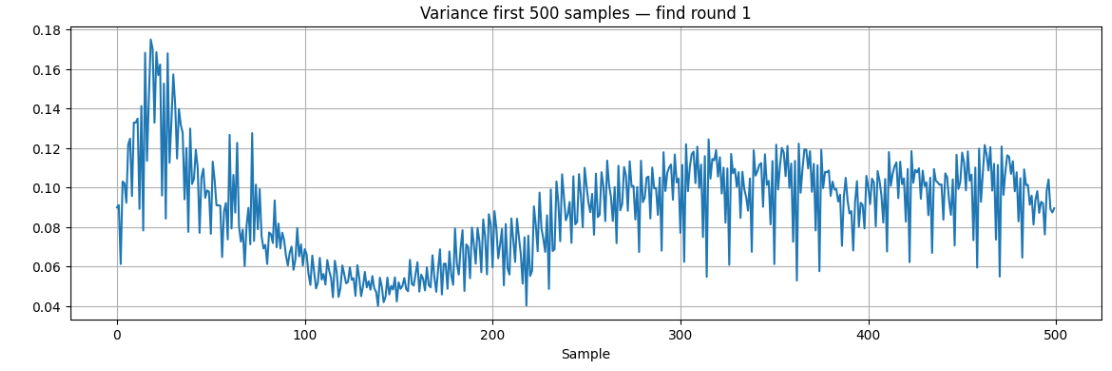
Variance plot shows highest activity in samples 0-80
-
PGE tracking with sbox_output model on samples 0-80 shows:
-
n=500: PGE=75
-
n=1000: PGE=61
-
n=3000: PGE=22
-
n=5000: PGE=27
PGE is generally decreasing which I believe to be on the right track. However we haven’t reached PGE=0 yet with 5000 traces.
Our setup:
-
CW305 Artix-7 100t with CV32E40P RISC-V soft-core at 50MHz
-
Software AES-128 in C (standard SubBytes/MixColumns loop implementation)
-
ADC at extclk_x4 (200MHz), clkusbautooff=True, cw.capture_trace()
-
sbox_output leakage model, window samples 0-80
Specific questions:
-
With your Ibex soft-core on CW305, approximately how many traces were needed to reach PGE=0 with software AES?
-
Our PGE fluctuates (went from 22 at n=3000 to 27 at n=5000), is that normal? Should we keep adding traces?
-
Is there a better window selection strategy, should we attack each byte separately with its own optimal window?
-
We only have one more lab session tomorrow. What is the minimum number of traces you’d recommend capturing to have a good chance of success?
This the jupyter notebook for your reference
Setup
scope.gain.db = 30
scope.adc.samples = 2000
scope.clock.adc_src = “extclk_x4”
target.pll.pll_outfreq_set(50E6, 1)
target.clkusbautooff = True
target.clksleeptime = 1
Capture
for i in range(N):
key, text = ktp.next()
ret = cw.capture_trace(scope, target, text, key)
if not ret:
continue
proj.traces.append(ret)
Attack with window 0-80
proj_n = cw.create_project(“attack”, overwrite=True)
for t in proj.traces:
trimmed = cw.Trace(t.wave[0:80], t.textin, t.textout, t.key)
proj_n.traces.append(trimmed)
attack = cwa.cpa(proj_n, cwa.leakage_models.sbox_output)
results = attack.run()
pge = results.find_maximums()[0][0][1]
corr = results.find_maximums()[0][0][2]