Hello everyone,
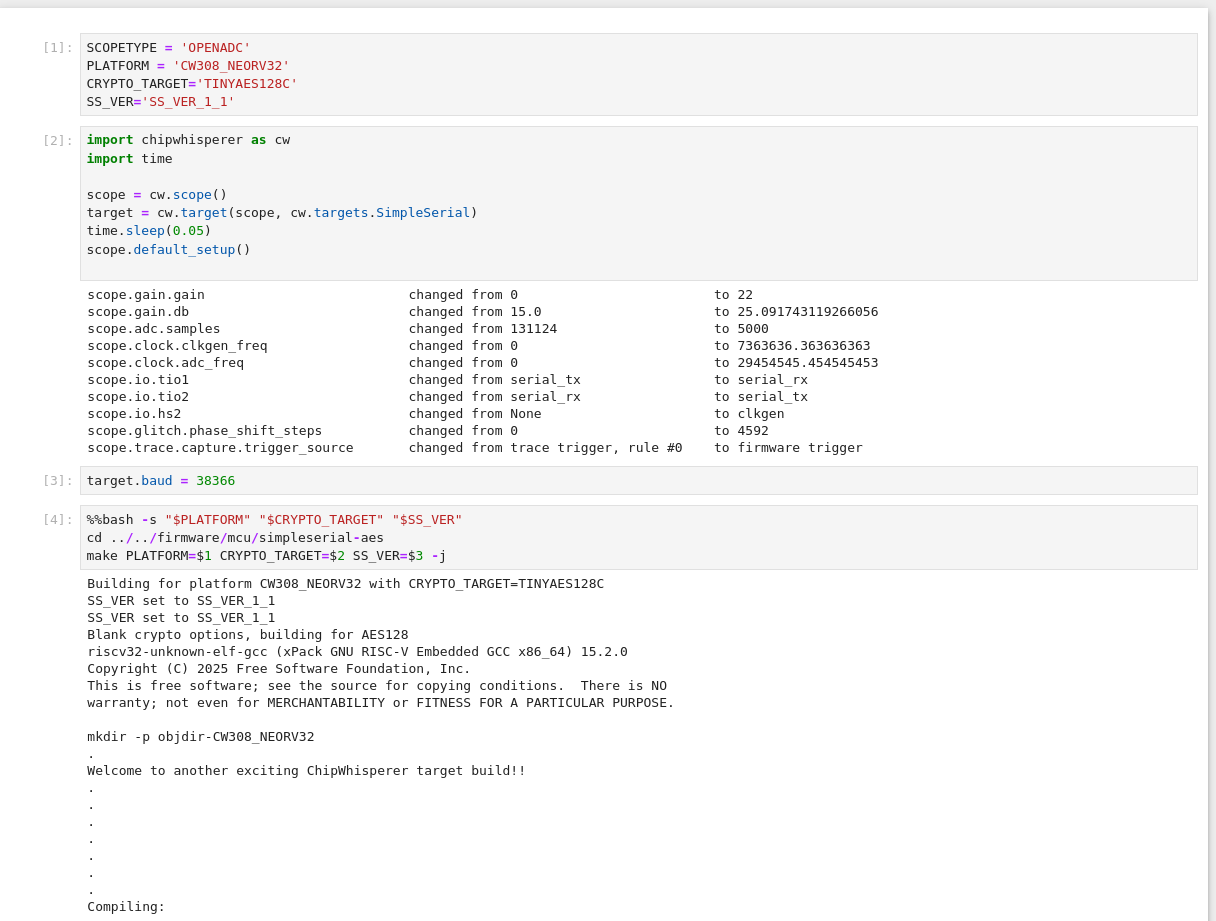
I am trying to capture power traces using ChipWhisperer Husky but I cannot get any UART communication with my custom FPGA target. I don’t use a ChipWhisperer reference hardware design, but a custom RISC-V–based FPGA design running on the CW312T iCE40(NEORV32 softcore).
I wrote the following script to load the FPGA bitstream manually:
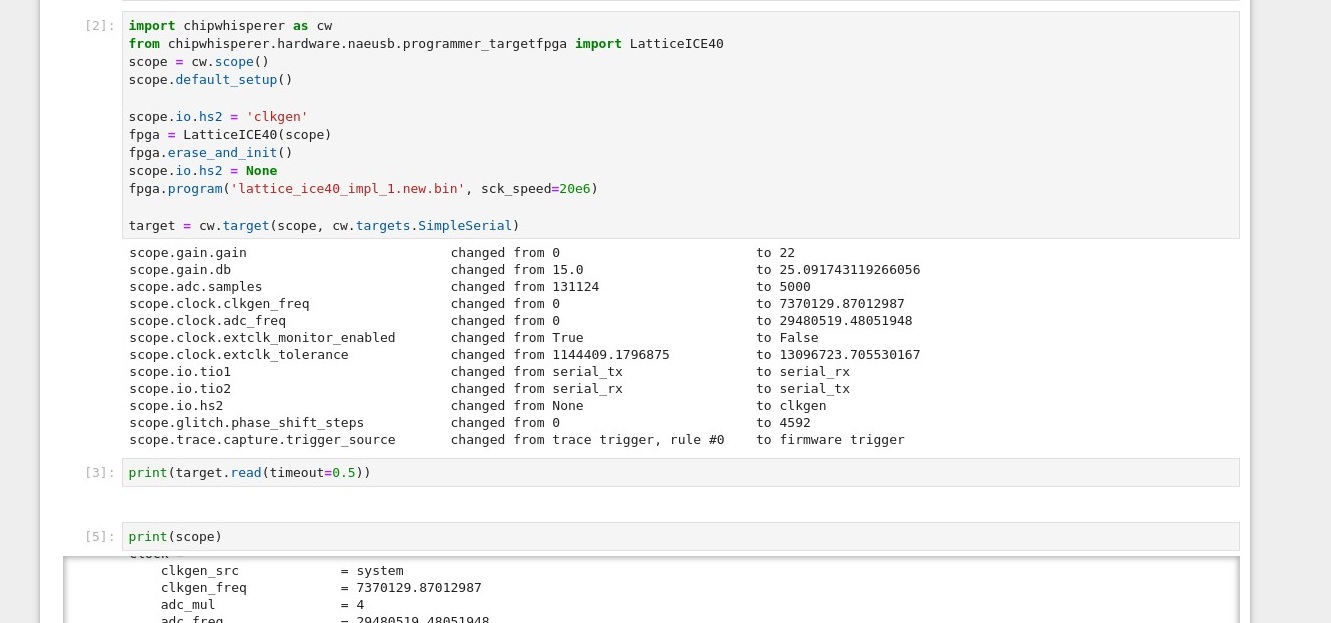
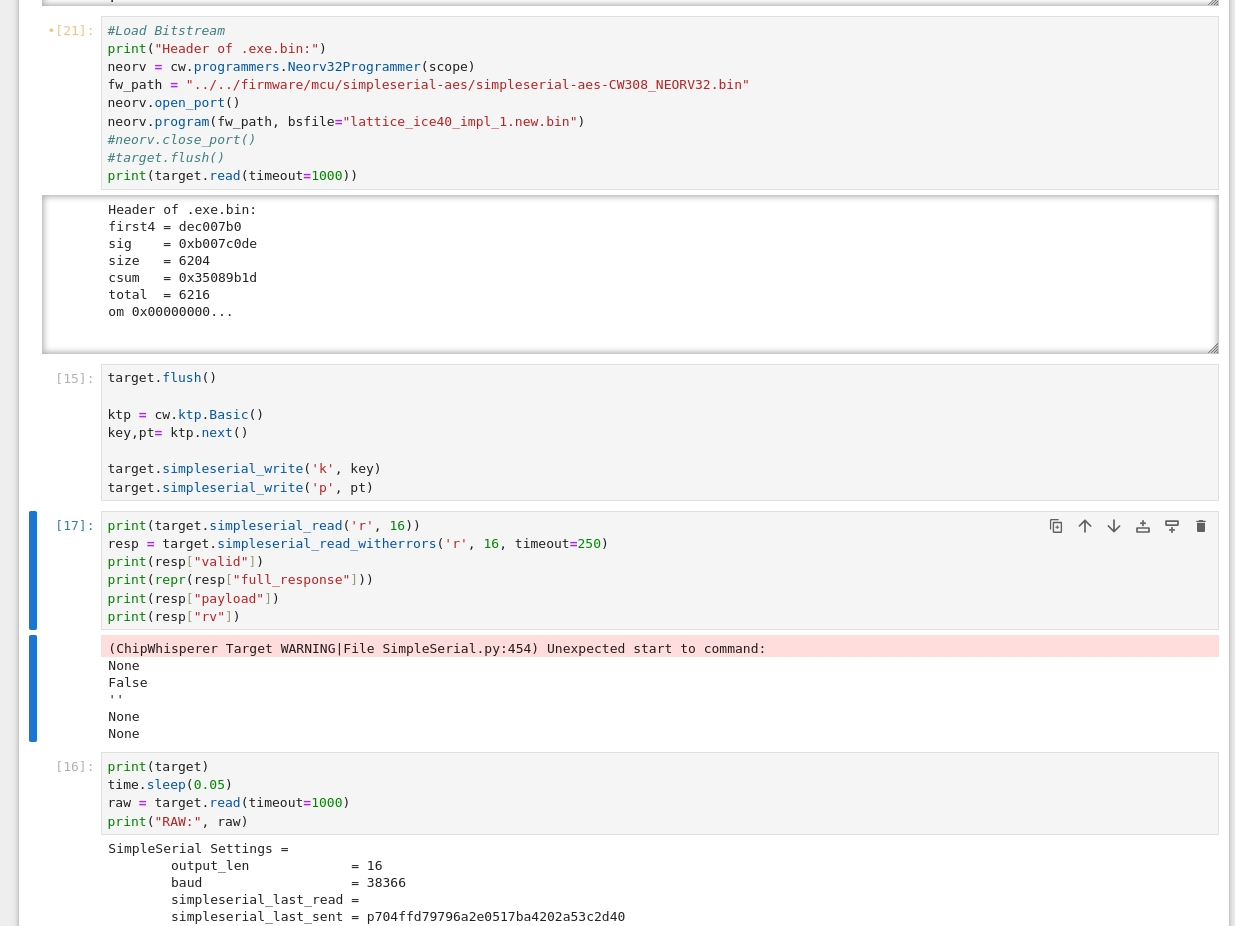
However, even after loading the bitstream, target.read() doesn’t return any data, and UART communication appears to be completely non-functional.
As a result, I encounter the following errors during uploading the firmware(simpleserial-aes.c) to the target:
OSError:b”Sync error with bootloader- invalid response to “h“ command()”
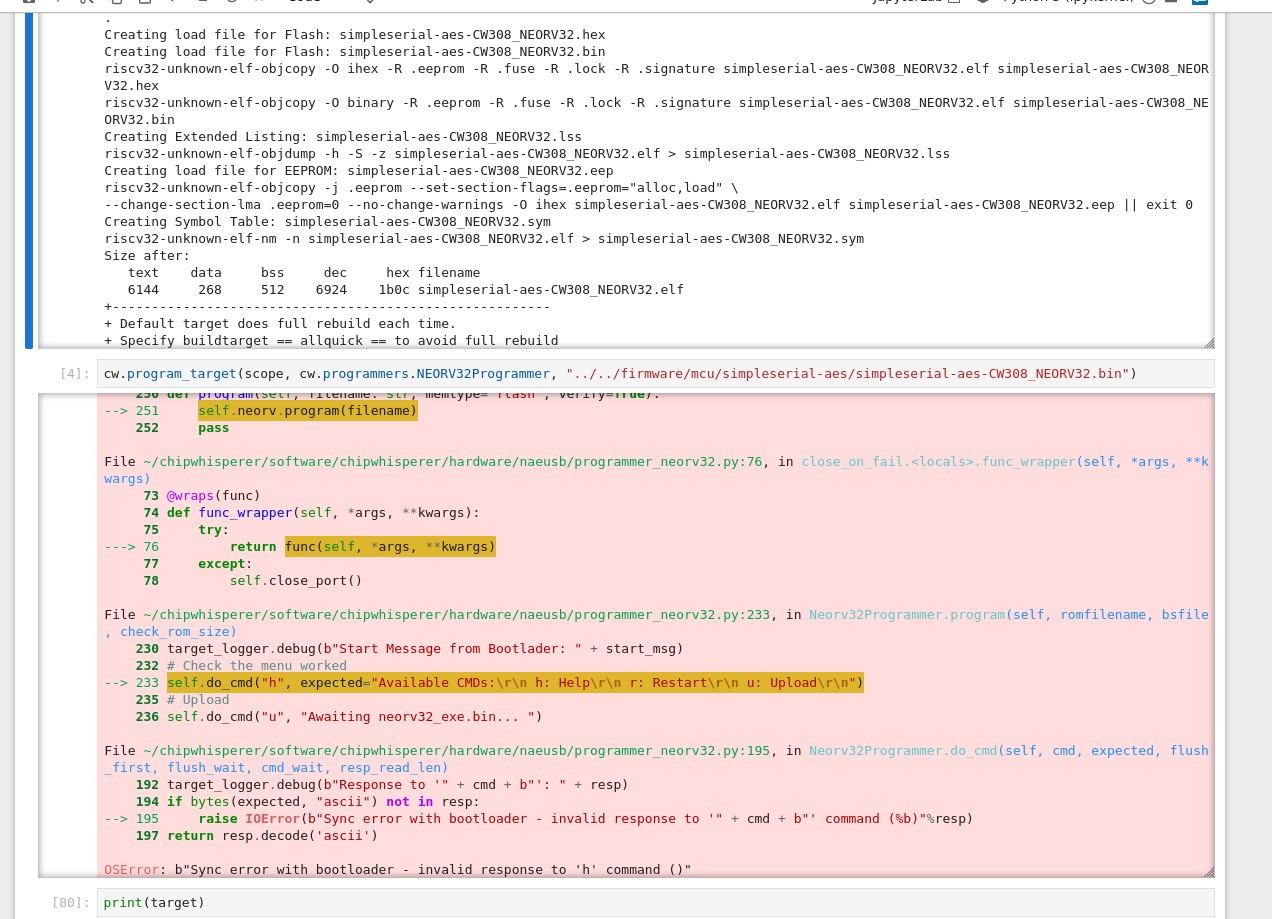
On the firmware side, I am using the standard ChipWhisperer simpleserial-aes.c firmware without functional modifications.
Environment & Setup
-
OS: Linux
-
Tool: ChipWhisperer Husky (Ver. 5.7.0) + CW313 baseboard
-
Target board: CW312T (Lattice iCE40)
-
Target core: custom NEORV32 (RISC-V)
-
Crypto: AES (TINYAES128C)
I am using SimpleSerial1_1:
SCOPETYPE = 'OPENADC'
PLATFORM = 'CW308_NEORV32'
CRYPTO_TARGET='TINYAES128C'
SS_VER='SS_VER_1_1'
For the pin mapping, I used the CW312 iCE40 constraints from the hdl/constraints repository as a reference (board iCE40CW312, constraints.pcf) and then created my own constraint file for my build flow (UART + trigger pins based on that reference).
Below is the constraint file I am currently using.
Constrait file
# Radiant pin mapping for CW312T-iCE40 board

## Clock
ldc_set_location -site B3 [get_ports clk_i]

## UART
ldc_set_location -site E5 [get_ports uart_txd_o]
ldc_set_location -site D5 [get_ports uart_rxd_i]

## SPI - on-board flash
ldc_set_location -site F1 [get_ports flash_sdo_o]
ldc_set_location -site D1 [get_ports flash_sck_o]
ldc_set_location -site C1 [get_ports flash_csn_o]
ldc_set_location -site E1 [get_ports flash_sdi_i]

## GPIO - on-board low-active LEDs
ldc_set_location -site A5 [get_ports gpio_o{0}]
ldc_set_location -site A1 [get_ports gpio_o{1}]


##set_io --warn-no-port iCE40CW312_CLK B3

#> UART
##set_io --warn-no-port iCE40CW312_TX E5
##set_io --warn-no-port iCE40CW312_RX D5


#> SPI [user port]
##set_io --warn-no-port iCE40CW312_SPI_SDO F1
##set_io --warn-no-port iCE40CW312_SPI_SCK D1
##set_io --warn-no-port iCE40CW312_SPI_CSN C1
##set_io --warn-no-port iCE40CW312_SPI_SDI E1


#> GPIO [input]
##set_io --warn-no-port iCE40CW312_GPIO_I[0] A5
##set_io --warn-no-port iCE40CW312_GPIO_I[1] A1


#> GPIO [output]
##set_io --warn-no-port iCE40CW312_GPIO_O[0] A5
##set_io --warn-no-port iCE40CW312_GPIO_O[1] A1
Goal
Capture power traces of a single AES encryption.
The trigger should be asserted during the encryption phase.
What I already tried
- Uncommenting
putch(‘h’);putch(‘e’); putch(‘l’); putch(‘l’); putch(‘o’); putch(‘\n’);in simpleseria-aes.c and manually testing communication withtarget.read()
But so far that haven’t resolved the issue.
At this point, I suspect a pin mapping or IO constraint issue, but I would appreciate any guidance on what to verify next or what might be missing in my setup.
Thank you in advance.