Hello,
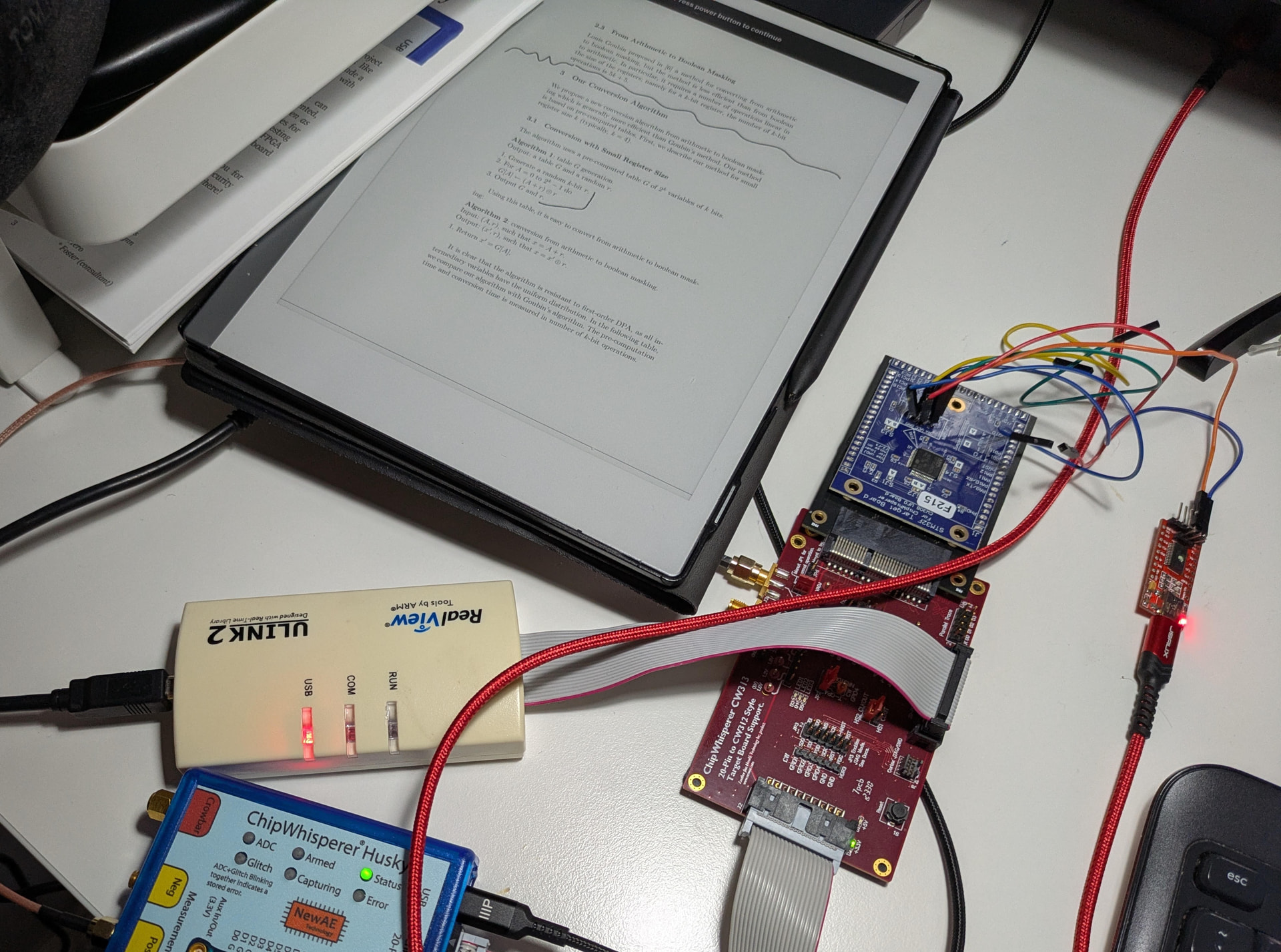
I’ve to say I’m pretty new to CWHusky hardware and operating it. I’m in a need to perform SCA testing on STM32F2. I’ve assembled the hardware (STM32F2 target + CW308→CW312 adapter board + CW313 target board support). I manged to connect it to CWHusky and ensure that it runs alright - that mean, I can implement some program, flash it to the board and see over UART that it works.
It seems I also can collect traces by triggering GPIO12 up/down.
scope.gain.gain = 45                # Increase gain (range typically 0-45)
scope.adc.samples = 8000            # Number of samples to capture (10000 = \~1.36 ms at 7.37 MHz)
scope.clock.clkgen_freq = 7370000   # 7.37 MHz
scope.adc.offset = 0                # Center the signal
scope.trigger.triggers = 'tio4'     # Use TIO4 for trigger
scope.io.tio1 = 'serial_rx'
scope.io.tio2 = 'serial_tx'

scope.io.target_pwr = 0
time.sleep(BOOT_WAIT)
scope.io.target_pwr = 1
time.sleep(BOOT_WAIT)
I wanted do ask 2 questions:
- Do I need to do something more to setup the target correctly? I understand that STM32F2 is not a “default” target that CWHusky is delivered with and hence I was wondering if CWHusky requires any additional configuration. I’m only interested in collecting power traces for DPA analysis on cryptographic schemes?
- What would be the best way to validate a setup? I’ve noticed that there is a lab called
Lab 2_1B - Power Analysis for Password Bypass (MAIN).ipynb. Would running that excersise successfully validate correctness of my setup? - Is it possible to configure the target to run faster than 7MhZ (but still be able to collect high quality traces)?
Any feedback on that will be more than welcome.
Kind regards,
HC